
P4P Statement
GENEVA | JUNE 12, 2026
Principles for Peace welcomes the 2026 Paris Call for the Two-State Solution
Principles for Peace welcomes the adoption of the 2026 Paris Call for the Two-State Solution, delivered at the Institut du Monde Arabe in Paris and addressed by Israeli and Palestinian leaders to Foreign Minister Jean-Noël Barrot, to be shared with the Heads of State and Government of the G7 and the global leaders convening in Evian the following week. Principles for Peace and the Uniting for a Shared Future coalition contributed to the policy inputs underpinning the Call and is proud to see the recommendations of Israeli and Palestinian peacebuilders carried directly into the diplomatic process.
Hiba Qasas, Founding Executive Director of Principles for Peace, kicked off the day with a high-level breakfast meeting with the foreign ministers of France, the UK and Canada: Jean-Noël Barrot, Yvette Cooper and Anita Anand.

The event itself then included EU High Representative Kaja Kallas, Commissioner Dubravka Šuica and more than a dozen foreign ministers: Canada’s Anita Anand, Ireland’s Thomas Byrne, Mexico’s Maria Teresa Mercado, Qatar’s Mariam bint Ali bin Nasser Al-Misnad, Spain’s Diego Martinez Belio, Brazil’s Mauro Viera, Iceland’s Þorgerður Katrín Gunnarsdóttir, Norway’s Andreas Motzfeld Kravik, Luxembourg’s Xavier Bettel, Egypt’s Mohamed Abou Bakr Saleh, the UAE’s Khalifa Shaheen Al Marar, Türkiye’s Musa Kulaklıkaya, Andorra’s Imma Tor Faus and Monaco’s Isabelle Berro-Amadeï.
Following extensive consultations involving Israeli and Palestinian peacebuilders, policymakers, diplomats, parliamentarians, experts and practitioners from the Uniting for a Shared Future coalition and the broader peacebuilding civil society, the Paris Call sets out a shared agenda for advancing a credible pathway to a two-state solution. It lays out eight demands for action: a permanent, monitored ceasefire with protection for civilians; the alignment of the New York Declaration, UN Security Council Resolution 2803, the 20-point plan, the Global Alliance and the Board of Peace into a single implementation pathway towards a two-state solution within a regional framework; a halt to annexation and settlement expansion with real consequences for settler violence; the reconstruction of Gaza with genuine Palestinian ownership; a human-centred, accountable mutual security framework; Palestinian governance renewal through elections and institutional reform, with urgent measures to prevent the collapse of the Palestinian Authority; regional integration as a catalyst for statehood and ending the occupation, not a detour around resolving the conflict; and the launch and resourcing of the International Fund for Israeli-Palestinian Peace, alongside a structured consultative mechanism for Israeli and Palestinian expertise.
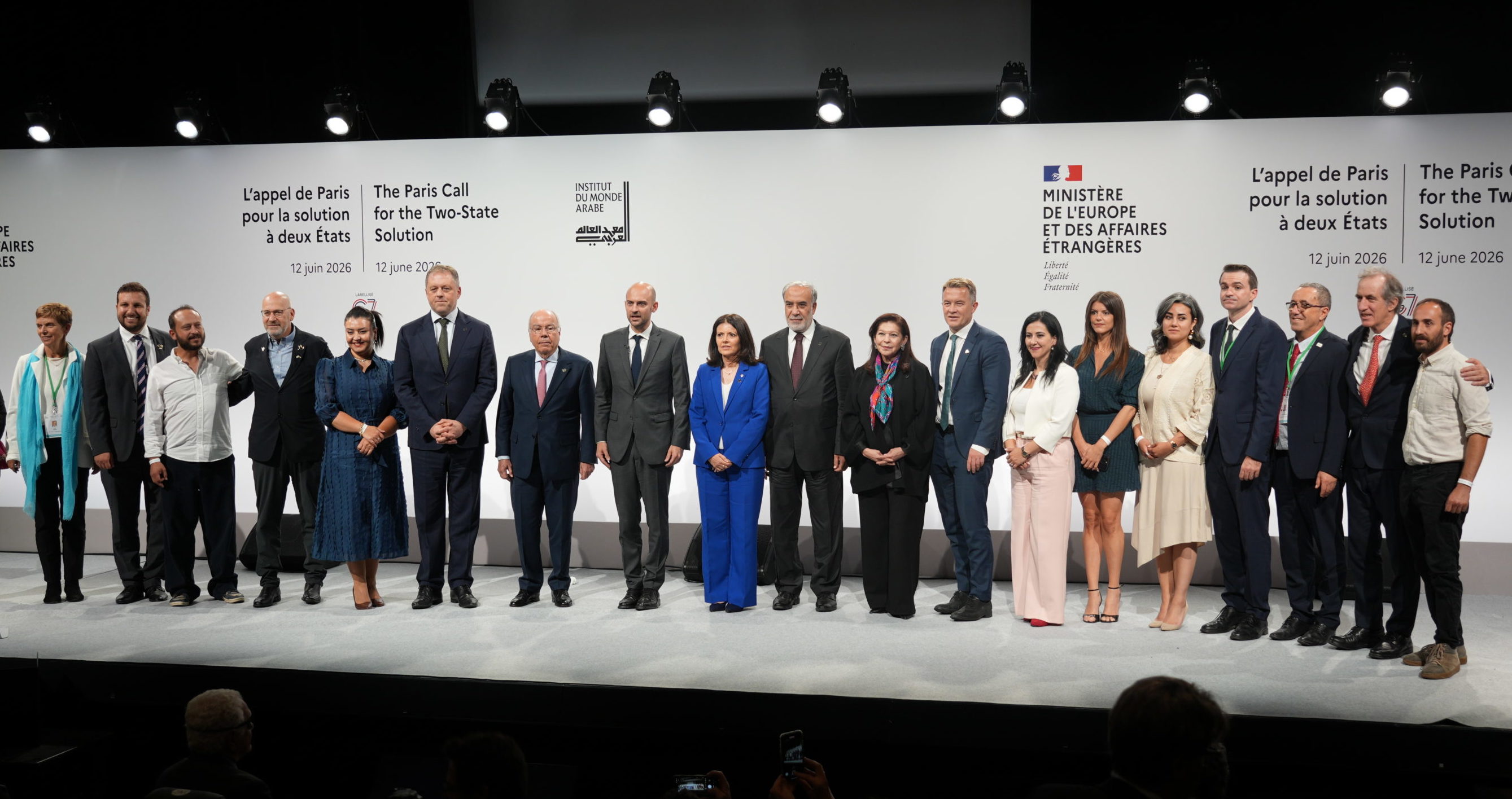
These demands speak directly to the agenda Principles for Peace and the Uniting for a Shared Future coalition have pressed at every station of this process, including before the UN Security Council in February 2026, where Founding Executive Director Hiba Qasas presented the coalition’s confidence-building measures and called for the political horizon to be anchored in the Israeli and Palestinian constituencies it must ultimately serve. The Call’s demand for an international peace fund comes one day after the United Kingdom, Australia and Canada launched precisely such an instrument, a step Principles for Peace welcomed and helped advocate for.
“This year’s Paris Call lands at a moment when a regional war has pulled attention away from the Israeli-Palestinian conflict, and when the threats to a two-state outcome, from annexation to the erosion of territorial contiguity, are existential”, said Hiba Qasas. “France is keeping the political horizon on the table when it would be easier to look away. We thank Minister Barrot for convening this effort, and all of the ministers who joined, and we are proud that the recommendations of the leaders we work with every day, Israelis and Palestinians who refuse to surrender the future, are at its core.”
The 2026 Call comes one year after the inaugural Paris Call, unveiled in June 2025 at an event convened by France’s Ministry of Europe and Foreign Affairs ahead of the High-Level International Conference co-chaired by France and Saudi Arabia. The arc between the two editions is the story of a constituency finding its political voice: from an initial appeal while conflict still raged in Gaza, to a structured set of demands to G7 leaders anchored in Israeli and Palestinian realities, and aligned with evolving international frameworks.
As these recommendations feed into the Evian summit and the implementation of the Comprehensive Peace Plan, Principles for Peace stands ready to support their translation into executable steps, and to continue working with all partners committed to a future of safety, dignity and freedom for both peoples.
